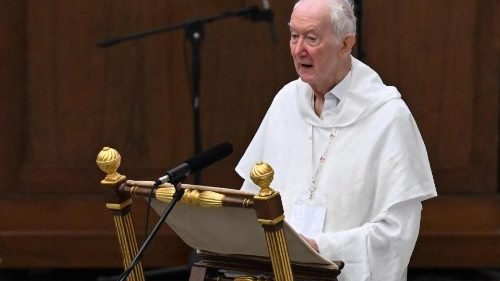
Reflecting on the process of drafting of the final synod document, Fr Timothy Radcliffe urges participants to speak “with freedom”, as “free children of God”.
Meditation by the Rev. Timothy Radcliffe, O.P.
Monday, 21st October 2024
We are about to embark on our last task, to consider the final document, amend and vote on it. Today we prepare ourselves to exercise this weighty responsibility. How are we do so?
With freedom! St Paul wrote to the Galatians, ‘For freedom, Christ has set us free.’ (5.1). Our mission is to preach and embody this freedom. Freedom is the double helix of the Christian DNA. First of all, it is the freedom to say what we believe and to listen without fear to what others say, in mutual respect. This is freedom of the children of God to speak boldly, with parrésia (e.g. Acts 4.29), as the disciples boldly declared the good news of the Resurrection in Jerusalem. Because of this freedom, each of us can say ‘I’. We do not have the right to keep silent.
This freedom is rooted in a deeper freedom, interior freedom of our hearts as we discover the decisions that are taken. We may be disappointed with the decisions of the Synod. Some of us will consider these to be ill-advised or even wrong. But we have the freedom of those who believe that, as St Paul wrote to the Romans, ‘God works all for the good of those who love him’ (Romans 8.28). And, we hope, even for those who do not! We can be at peace because ‘nothing can separate us from the love of God’, not even incompetence, not even mistakes. Because of this freedom, we can dare to belong to the Church and say ‘We.’
The heart of our decision making is this double helix of graced freedom. For God’s freedom operates in the very depths of our own free thinking and deciding. St Thomas Aquinas taught that grace perfects nature. It does not destroy it. When St Thomas asked how the wise men managed to get to Bethlehem so quickly he replied that it was due to the grace of God and the speed of the dromedaries[1]!
Let consider briefly each dimension of this graced freedom. A priest once began his homily at the evening Mass saying ’This morning I had no time to prepare and so I had to rely on the Holy Spirit. Now I have had time to think for myself and so I hope to do better!’ He was not a Dominican or even a Jesuit! Belief in the Holy Spirit does not excuse us from using our minds as we search for the truth. Thomas asserted that it would be an insult to the Holy Spirit not to think about decisions and, for example, draw lots. Vivian Boland OP said, ‘we are children of God so that in our thinking desiring, fearing and preferring, the Holy Spirit too is at work[2].’
In a play called A Man for all Seasons, St Thomas More implores his daughter Meg to honour our God-given ability to think: ‘Listen, Meg, God made the angels to show Him splendour, as He made animals for innocence and plants for their simplicity. But Man He made to serve Him wittily (intelligently), in the tangle of his mind.[3]’
Yves Congar was silenced by Rome. He was even exiled to England, a terrible fate for a Frenchman! Strangely he never appreciated our cuisine! In the depths of this crisis, he wrote in his diary, that the only response to this persecution was ‘to speak the truth. Prudently, without provocative and useless scandal. But to remain – and to become more and more – an authentic and pure witness to what which is true.[4]’
We need not be afraid of disagreement, for the Holy Spirit is at work in it. One day a man came to his rabbi to complain about his wife. At the end of the conversation the Rabbi said to him: ‘My friend you are absolutely right, you are justified!’ That afternoon the wife of the man came to the Rabbi and complained about her husband at great length. At the end of the conversation, the Rabbi said to the woman: ‘My friend, you are absolutely right, you are justified!’ When the woman was gone the Rabbi’s wife said to him: ‘But you’re absolutely mistaken. You cannot say that both of them are right, that both of them justified.’ And the Rabbi said to his wife: ‘You are right!’
So this is our freedom, to think, speak and to listen without fear. But this is nothing unless we also have the freedom of those who trust that ‘God works all for the good of those who love God.’ So we may be at peace with whatever is the result. As the fourteenth century English mystic Julian of Norwich famously said, ‘All shall be well; all manner of things shall be well.”. God’s providence is gently, silently at work even when things seem to go wrong.
God’s providence is woven into the story of our salvation from the beginning. The fall of Adam and Eve becomes through God’s grace the felix culpa which leads to the incarnation. The hideous death of Our Lord on the cross leads to Christ’s triumph over death.
So even if you are disappointed by the result of the Synod, God’s providence is at work in this Assembly, bringing us to the Kingdom in ways that God alone knows. His will for our good cannot be frustrated. During the retreat I quoted Cardinal Consalvi’s reply to the alarmed monsignor who said that Napoleon wished to destroy the Church: ‘Not even we have succeeded in doing that.’ When Abraham thought that he was required to kill his beloved only son, the Lord provided the ram stuck in the bushes. ‘On the mountain, the Lord will provide.’ (Genesis 22.14)
Often we can have no idea as to how God’s providence is at work in our lives. We do what we believe to be right and the rest is in the hands of the Lord. This is just one synod. There will be others. We do not have to do everything, just try to take the next step. St. Teresa of Avila wrote at the end of her long and difficult life, ‘It is we who have begun the work; it is up to those who follow to keep on beginning[5]’. How we do not know. That is now out business.
Like Congar, Henri de Lubac SJ endured persecution prior to the Council. But in the midst of that suffering he wrote the beautiful and serene Méditation sur l’Eglise[6], a hymn of love to the same Church that was persecuting him. He wrote: ‘Far from losing patience, [the person who is persecuted] will try to keep the peace, and for his own part make a big effort to do that hard thing – retain a mind bigger than its own ideas. He will cultivate “that sort of freedom through which we transcends what involves us most remorselessly…He will avoid ‘the terrible self-sufficiency which might lead him to see himself as the incarnate norm of orthodoxy, for he will put “the indissoluble bond of Catholic peace” (quoting St Cyprian) above all things…[7]’ I hope that he will be canonised soon!
If we have only the freedom to argue for our positions, we shall be tempted by the arrogance of those who, in the words of de Lubac, see themselves as ‘the incarnate norm of orthodoxy.’ We shall end up beating the drums of ideology, whether of the left or the right.
If we have only the freedom of those who trust in God’s providence but dare not wade into the debate with our own convictions, we shall be irresponsible and never grow up. God’s freedom works in the core of our freedom, welling up within us. The more that it is truly of God, the more it is truly our own. As the free children of God, we can each say ‘I’ and together say ‘We.’
Footnotes
[1] ‘partim quidem adducti divina virtute, partim autem dromedariorum velocitate’ (Summa theol. III q.31 a.6 ad 3).
[2]Unpublished homily for Easter Week 4, Sunday, Year A
[3] By Robert Bolt
[4] Journel of a Theologian 1946 – 1956, translated by Denis Minns OP, ATF, Adelaide, 2015, p.340. From Journal d’un théolgien 1946 – 1956, Edition du Cerf, Paris, 2000, p.271.
[5] Quoted by McVey, Dialogue, p.55
[6] Written between 1945 and 1950
[7] I quote from The Splendour of the Church¸trans by Michael Mason, Sheed and Ward, London and New York, 1956, p. 187