

Pope Leo XIV encourages leaders of ecclesial movements and lay associations to guide those under their care with discernment and transparency, so that they may remain open to the world and grounded in communion.
By Devin Watkins
Pope Leo XIV met on Thursday with participants in a meeting of Moderators of associations of the faithful, ecclesial movements, and new communities, which was promoted by the Dicastery for Laity, Family, and Life.
In his address, the Pope reflected on governance in the Church, noting that leadership of any organization is critical to the group’s success and longevity.
Governance, he said, involves giving “a sure direction, so that the community may be a place of growth for the people who belong to it.”
In the Church, leadership is not only about coordinating practical matters but more importantly about acting as an expression of God’s saving will in Christ.
Pope Leo noted that governance in lay associations is entrusted to lay people by their communities, which vote for them in freedom.
He then pointed to three consequences of leaders’ reception of this gift of the Holy Spirit.
Leadership, he said, must benefit the entire community, not personal interests, and it must never be imposed, but rather recognized and freely accepted.
Finally, leadership in the Church is a charism that must be exercised in coordination with and subjected to the discernment of the Bishops.
“Certain characteristics must always be present in governance: mutual listening, co-responsibility, transparency, fraternal closeness, and community discernment,” said the Pope. “I would also like to recall that good governance, instead of concentrating everything on itself, promotes subsidiarity, and the responsible participation of all members of the community.”

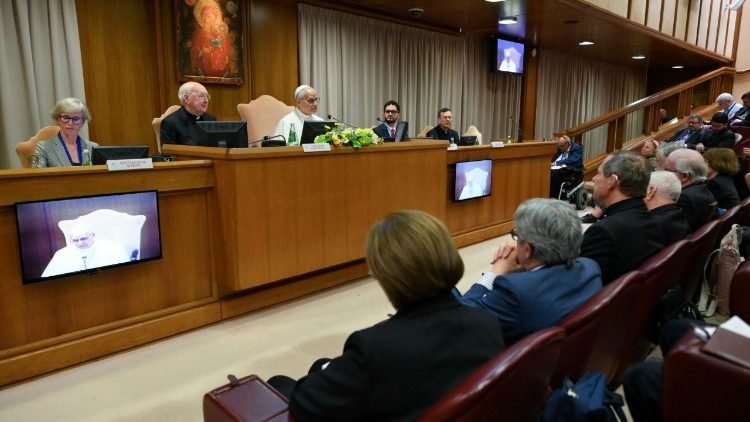
Pope Leo speaks to the lay Church leaders (@Vatican Media)
Pope Leo then reflected on the prophetic role of lay leaders in the Church, noting this requires listening to current pastoral needs in order to respond to new challenges.
“Belonging,” he said, “is authentic and fruitful when it is not exhausted in participation in activities internal to the group, but interprets the signs of the times and reaches outward, addressing everyone, the culture of the time, and fields of mission not yet explored.”
At the same time, lay associations and ecclesial movements are called to embrace communion among themselves and with the universal Church.
Speaking off-the-cuff, Pope Leo noted that some groups get the idea that theirs is the only authentic charism. However, he warned, ecclesial movements must live in communion with the entire Church and with their local Bishop, even if they disagree with him.
Returning to his prepared remarks, the Pope said Church leaders must listen to various opinions, cultural contexts, and personal temperaments, while seeking to preserve the “higher good of communion.”
Pope Leo XIV invited lay leaders to bear witness through meekness, detachment, and selfless love, as they express the founding charism of their movements.
“Every authentic charism already includes within itself fidelity and openness to the Church,” he said.
Finally, the Pope praised the work and history of lay associations and ecclesial movements, saying many well-formed people and effective evangelizers have emerged from them.
“Preserve and, with the grace of God, help all these gifts to grow!” he concluded. “The Church supports and accompanies you.”

