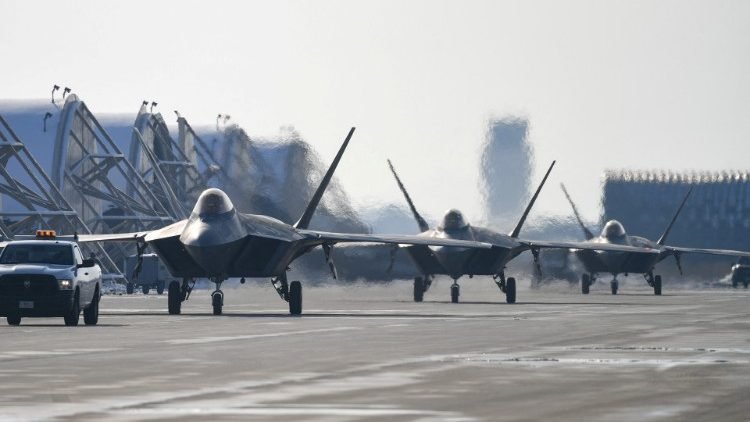
The Justice and Peace Commission of the Japanese Bishops’ Conference writes to Prime Minister Fumio Kishida and the Japanese Defense Minister asking them to withdraw three key documents which provide for rearming the country and revising its defense strategies.
By Lisa Zengarini
Japan’s Catholic Bishops have voiced their strong opposition to a new rearmament plan approved by the Japanese government, saying it is unconstitutional and dangerous.
A $320 billion plan
On December 16, Prime Minister Fumio Kishida unveiled a major overhaul of Japan’s defense strategy, which will see the country implement a more than $320 billion plan (2% of its GDP) to build up its military in the next five years.
The plan would reportedly include not only upgrading Japanese-made weapons, but also acquiring at least 400 U.S.-made long-range Tomahawk cruise missiles.
The Cabinet has also approved other two documents on National Security Strategy and the National Defense Strategy, outlining a new policy that would give Japan the ability to launch counterstrikes, though only under specific circumstances. Previous Cabinets have taken the stance that Japan should not possess a counterstrike capability.
The Prime Minister explained the move as a response to regional threats, also citing Russia’s invasion of Ukraine as a factor in the defense buildup.
An unconstitutional and undemocratic decision
In a statement released this week, the Japanese bishops’ Justice and Peace Commission (JPC), urges the Kishida’s government to withdraw the three documents and strongly criticizes the new defense policy which, it says, “abandons the conventional basic policy of an exclusively defence-oriented posture under Article 9 of the Japanese Constitution, and marks a complete shift making Japan a military superpower.”
The message also notes that such an important decision was made by government decree, bypassing the Japanese parliament, and is thus undemocratic.
According to the JPC developing a capability to attack enemy bases is nothing more than a “threat of force” which is explicitly prohibited by the Constitution. Furthermore, boosting military spending to 2 per cent of GDP by 2027, almost double the current level, means “declaring Japan’s military superpower status”.
The Justice and Peace Commission is also concerned about using civilian ports and airports for military purposes and directing scientific and technological research to develop new weapons. The statement further mentions the deployment of long-range missiles on the Nansei Islands, near Taiwan, and the risk that the local inhabitants will be sacrificed like those in Okinawa during the Second World War.
Japan should follow the path of peace through diplomacy
Citing Pope Francis’ words during his Apostolic Journey to Japan in 2019 the JPC concludes reiterating that “The path Japan should follow is that of peace through diplomacy based on the Preamble and Article 9 of the Japanese constitution, playing a role in creating a framework for peace that resolves disputes through dialogue.”