

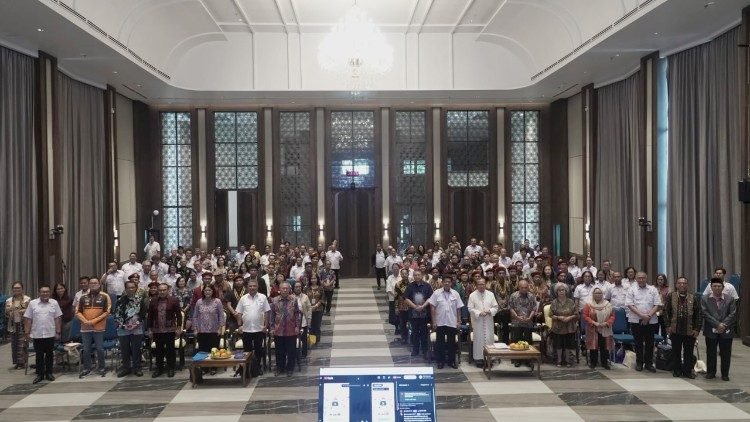
The Indonesian Catholic Society Forum launches a five-year plan to bring Catholic social teaching into public life through civic education, policy advocacy and leadership formation.
By Fr. Kasmir Nema, SVD, Lisa Esti Puji Hartanti, and Paskalia
At a national meeting in Jakarta, Catholic lay leaders called for greater civic engagement and renewed commitment to the common good in response to what they described as a “multidimensional crisis” facing Indonesia.
Held from 23 to 25 October at the headquarters of the Indonesian Bishops’ Conference (KWI), the National Working Meeting of the Indonesian Catholic Society Forum (Forum Masyarakat Katolik Indonesia, FMKI) brought together around 80 lay leaders from across the archipelago to examine the country’s social and political challenges and set priorities for the Forum’s work over the next five years.
‘Salt of society’
The meeting opened with Mass presided over by Bishop Yohanes Harun Yuwono, Chair of the Bishops’ Conference Commission for the Lay Apostolate.
Although Catholics constitute a minority in Indonesia, they are called to serve society, the bishop said in his homily.
“We may be a small flock, seemingly powerless, but our true calling is to be the salt of society,” he said, affirming the Church’s role in promoting change and renewal in the country.

The National Working Meeting of the Indonesian Catholic Society Forum
The Mass was followed by a national dialogue entitled “Loving Indonesia: Nurturing Wisdom, Safeguarding the Civility of the Republic.”
Cardinal Ignatius Suharyo, Archbishop of Jakarta, delivered the keynote address. The panel brought together Catholic and Muslim perspectives, with contributions from Prof. Purnomo Yusgiantoro, Fr. Yohanes Kurnianto Jeharut, Prof. Syafiq A. Mughni, and Alissa Qotrunnada Munawaroh Wahid.
FMKI Chairman Aloysius Dewanto Handoko described the gathering as an important step in strengthening the role of Catholic laypeople in public affairs.
“This gathering marks a new chapter for FMKI, inspired by the social teaching of the Church, to strengthen the role of Catholics in the life of the nation and the state,” he said.
Addressing the nation’s challenges
Participants examined Indonesia’s social and political situation, drawing on national statistics and international assessments of governance, democracy and corruption.
According to Indonesia’s Central Statistics Agency, 8.07% of the population, or approximately 22.93 million people, lived in poverty in March 2026. The poverty rate was higher in rural areas, at 10.67%, than in urban areas, at 6.34%.
While acknowledging the government’s 2025–2029 development agenda, which includes food and energy security, human resource development, job creation, rural development and anti-corruption measures, the Forum expressed concern about what it sees as the recentralisation of power and the expanding role of the military in governance.

The National Working Meeting of the Indonesian Catholic Society Forum
Such developments, it warned, could undermine democratic processes and public accountability.
FMKI also cited international assessments pointing to challenges in democratic governance, press freedom and corruption. Freedom House classified Indonesia as “Partly Free,” awarding it 56 out of 100 in its 2026 assessment. Transparency International’s 2025 Corruption Perceptions Index gave the country a score of 34 out of 100, ranking it 109th among 182 countries.
The Forum called for independent oversight of major government programmes, including the Red and White Village Cooperatives and the Free Nutritious Meals initiative, to ensure that they serve the public interest rather than political interests.
It also stressed the importance of an independent civil society capable of scrutinising public policy, defending the common good and helping maintain a balance of power.
Three priorities for Catholic laypeople
Drawing on the 2026 Pastoral Note of the Indonesian Bishops’ Conference, FMKI identified three strategic priorities for its work.
The first is to consolidate and restructure the organization by bringing together lay Catholics from diverse professional backgrounds. Its activities will include civic and political education, policy research and advocacy, economic empowerment, leadership formation, and social solidarity.
The second is to bring Catholic social teaching more actively into public life. This will involve strengthening political literacy, accompanying communities and young people, conducting independent policy research, and engaging in non-partisan advocacy. FMKI also intends to collaborate with civil society organisations, educational institutions, and interfaith groups.
The third is to develop new leaders committed to integrity and the common good. The Forum aims not simply to prepare Catholics for political office, but also to encourage responsible leadership in government, civil society, professional life and local communities.
These priorities will guide FMKI’s 2026–2031 work programme, which covers 12 areas, including spirituality and ethics, interreligious relations, law and advocacy, environmental protection, and public health. The programme also includes a dedicated task force for Papua.
“FMKI’s programmes are not focused on politics alone. They embrace society as a whole, including Indigenous communities,” Handoko said. “They are a means of raising a prophetic voice and improving the lives of the Indonesian people.”
The Forum grounds its mission in Catholic social teaching, Pancasila—Indonesia’s state philosophy—and the 1945 Constitution.
Founded on 15 August 1998, during Indonesia’s Reformasi period, FMKI serves as a platform for Catholic laypeople engaged in the country’s social and political life. Its new programme seeks to strengthen their contribution to public affairs and encourage a more just, accountable, and humane society.

