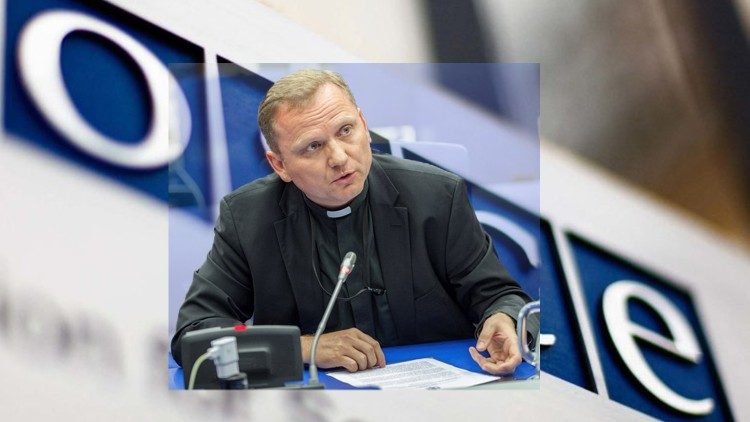
The Permanent Representative of the Holy See to the Organization for Security and Cooperation in Europe, Archbishop Janusz Urbańczyk reaffirms the need for collective efforts in the fight against corruption in a statement to OSCE.
By Benedict Mayaki, SJ
The Holy See has reaffirmed its stand in combatting corruption and has highlighted the important role of governments, civil society, faith-based organizations and corporations in contrasting the phenomenon in society.
Archbishop Janusz Urbańczyk, the Permanent Representative of the Holy See to the Organization for Security and Cooperation in Europe (OSCE) said this in a statement on Monday at the opening session of the 2021 Economic and Environmental Dimension Implementation Meeting.
The meeting was dedicated to “Taking stock of the implementation of the OSCE commitments in the field of anti-corruption and good governance.”
Fighting corruption
Archbishop Urbańczyk highlighted the importance of keeping the fight against corruption in focus. In this regard, he pointed at the Ministerial Council decisions on the need for combating corruption and its indispensable connection to good governance.
He also noted that in the 1999 Charter for European Security, the participating states recognized that “corruption poses a great threat to the OSCE’s shared values. It generates instability and reaches into many aspects of the security, economic and human dimensions.”
All hands on deck
Stressing that corruption is not an issue that can be solved by governments alone, Archbishop Urbańczyk highlighted the “important contribution made by civil society organizations, corporations, faith-based organizations, and research institutions in supporting States’ effort to contrast corruption.”
“Corruption is a phenomenon that is not limited by politics or geography. It exists in rich countries and in poor countries,” the Vatican Observer said.
“By betraying ʻmoral principles and the norms of social justice,ʼ corruption hampers the attainment of integral development and the eradication of poverty,” he noted. “By undermining trust in public institutions and between the governing and the governed, it compromises the good functioning of a well-organized society.”
Bringing his address to a close , Archbishop Urbańczyk highlighted that there are still significant reasons why OSCE should maintain anti-corruption issues on the agenda, “as a comprehensive approach to security needs to factor in its many detrimental effects.”