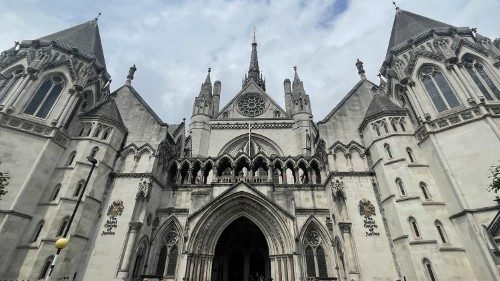
Today, July 18, the civil proceedings at the High Court of Justice concludes, with lawyers for both parties submitting closing statements. The case was initiated following financier Mincione’s 2020 lawsuit regarding the purchase of the Sloane Avenue building.
By Salvatore Cernuzio
“No good faith,” one side reiterates. “No fraud,” the other asserts.
With the reading of the closing submissions from the lawyers of the Secretariat of State and financier Raffaele Mincione, the civil trial in London at the High Court of Justice of the United Kingdom regarding the purchase of the Sloane Avenue building concluded today, Thursday, July 18.
The trial began on June 24, following the 2020 lawsuit filed by Mincione seeking several favorable declarations to attest to his “good faith” in the 2018 transaction with the Secretariat of State for the London property.
The trial at the Royal Court of Justice featured Archbishop Edgar Peña Parra, who in his testimonies on July 4, 5, and 8, detailed the events central to the criminal proceedings before the Vatican Tribunal, which concluded in December 2023 with the conviction of ten defendants, including Mincione himself.
Closing statements
Lawyers for both parties submitted their closing statements in the London case on Thursday. Their arguments were formulated in light of the courtroom debate and based on documentary evidence and technical evaluations of the property in the prestigious Chelsea district. A verdict is expected in the fall.
Mincione’s lawyers: No fraud
The 115-page submission by Mincione’s legal team, signed by lawyer Charles Samek and associates, admits their client’s particular style (“He is a buccaneering type”) but refutes the claim that the Secretariat of State was defrauded: they allegedly “realized they were victims” only “after reading the documents related to the Swiss authorities’ request for judicial assistance,” the lawyers state.
They also refute the notion that Mincione aimed to influence the Vatican trial: “The ongoing proceedings would never have had any effect.” One objective of this trial, they assure, is to “assert the financier’s rights.”
If someone claims to be a fraud victim, they should appear in court with “clean hands and nothing to hide. With all due respect, this is not what happened here…”.
Payments to Torzi
The lawyers argue that the Court has not been given a complete picture and claim that Archbishop Peña Parra, despite arriving in the Vatican in October 2018, was “directly involved” in all the final negotiations – specifically, those that led to paying Torzi €15 million to sever all ties and transfer the property shares to the Holy See, over which he had total control.
Mincione’s lawyers also revisited the invoices to Credit Suisse for two transfers to Torzi’s companies, Sunset Enterprises and Lighthouse, invoices referring to broker services never rendered. Samek claimed in court that the invoices were “false”; while Peña Parra framed them as a consequence of what Vatican judges labeled extortion.
The property price
Finally, the lawyers asserted that, given the market valuation of the property, the Secretariat of State’s claim of having purchased “an empty box” at an inflated price does not hold.
“Without this overvaluation, there is no fraudulent falsification of the market value, and the basis for the alleged conspiracy with Torzi/Squillace falls apart.”
Overpriced property
The issue of the overpriced property occupies much of the 109-page submission by the Secretariat of State’s lawyer, Charles Hollander, and associates.
Numerous paragraphs chronologically trace the history of the former Harrods warehouse on Sloane Avenue, purchased by Mincione in December 2012 for £129 million plus £8 million in costs.
The figures stand “in stark contrast,” the lawyers assert, to the information provided to the Administrative Office of the Secretariat of State, which received a purchase proposal with a gross valuation of about £230 million and a yield of 3.75%.
Mincione, the lawyers recall, has always spoken of “a gap between one valuation and another,” the effects of Brexit, and “interest rate cuts” that “were plummeting.” In reality, “there is no evidence of any interest rate changes between late 2013 and early 2014,” the document states, also mentioning “misleading” information in letters delivered by the financier and his associates to the Secretariat of State.
Relations between Torzi and Mincione
Hollander and the other lawyers of the Secretariat of State then outline the elements they claim demonstrate that the “financial interests” of Mincione and broker Gianluigi Torzi were “closely intertwined.”
The two were linked by “a series of other transactions where they were mutual financiers,” they assert, and “both were short of money and urgently needed cash due to agreements related to the Banca Carige affair.”
In these circumstances, the Secretariat of State represented an “easy target” because “for years, Mincione had been deceiving and embezzling money from the Secretariat of State.”
Media verdict
The submission then claims the criticisms against Archbishop Peña Parra are “unfounded” and sometimes even “gratuitous (but obviously reported by the press),” the Secretariat of State’s lawyers write.
For them, “this proceeding has no valid and sensible purpose” or, perhaps, “the real purpose” is only to secure a verdict to fuel media frenzy.
“Rehabilitate his name”
The conclusions focus on the reasons that drove Mincione to initiate the legal action four years ago, namely the desire to “rehabilitate his name” while investigations were underway in the Vatican.
It is currently “impossible” to achieve this rehabilitation, the lawyers write, after a first-instance conviction to five and a half years in prison and a request for €180 million in damages, along with a significant confiscation order.
The lawyers also point out inaccuracies regarding the alleged “prejudices” the financier would have suffered due to media pressure from the Secretariat of State’s accusations, compromising his business activities or triggering regulatory actions like that of the CSSF (Commission de Surveillance du Secteur Financier) in Luxembourg.
The latter – and it was Mincione’s own witnesses who stated this in court – dates back to June 2019, “before any news reported by the press about the Vatican investigation or even before the start of that investigation.”
Timing of the lawsuit
On timing, the submission notes that Mincione’s legal action began eleven days after Torzi’s arrest in the Vatican.
“It seems that when prosecutors knocked on the doors of Mincione and his collaborators (particularly Torzi), Mincione and the other plaintiffs decided together to initiate their own proceedings.”
They thought – “erroneously,” the lawyers emphasize – that by doing so, “they could exert pressure” on the Office of the Promoter of Justice in the Vatican proceedings or “somehow manage the (understandable) negative consequences” of being accused of “serious criminal activities.”
In short, according to the lawyers, “the plaintiffs’ real goal was to launch a ‘counteroffensive against media interest in the investigation” by the Promoter of Justice.
“Bizarre” continuation
Mincione was convicted in the first instance for embezzlement, money laundering, and private corruption by the Vatican Tribunal but acquitted of aggravated fraud and embezzlement concerning the alleged overvaluation of the Sloane Avenue property sale price.
The reasons for the sentence have not yet been made public, but the Promoter of Justice, Alessandro Diddi, has already declared his intention to appeal.
The Secretariat of State, however, has not filed any appeal.
“Therefore,” the statement concludes, “a ‘victory’ for Mr. Mincione in this proceeding would give him nothing more than what the Vatican Tribunal has already given him.” Indeed, “the continuation of the proceedings” would be rather “bizarre,” they claim.