

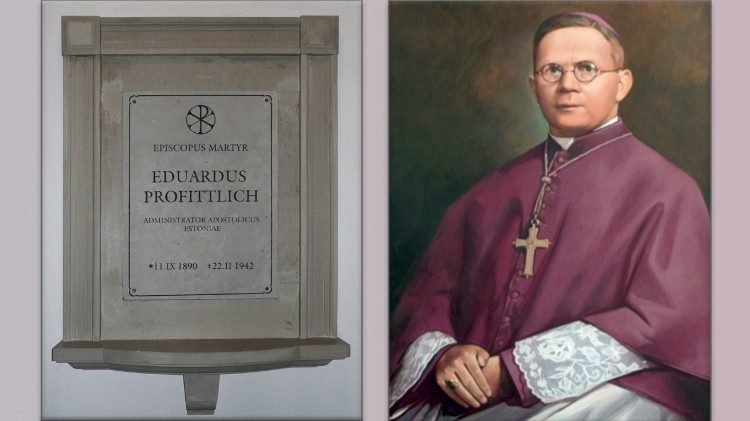
As Pope Francis makes an Apostolic Visit to Estonia on 25 September, the country’s Catholic Church is revisiting its roots and finding inspiration in its first bishop, Servant of God Eduard Profittlich.
Pope Francis will visit Estonia on the last leg of his Apostolic Visit to three Baltic nations, also making stops in Lithuania and Latvia.
Marge-Marie Paas, postulator for the diocesan phase of Profittlich’s Cause for Canonization and Communications Coordinator for the Pope’s trip to Estonia, spoke to Devin Watkins about the life and legacy of the nation’s first Catholic bishop.
Pope Francis will make a brief stop at St. Peter and St. Paul Cathedral before lunch on Tuesday. Ms. Paas says the Pope is likely to stop for a moment to pray before a memorial plaque of Servant of God Eduard Profittlich.
“I can already imagine this moment,” she said. “The story of Eduard Profittlich will touch not only Pope Francis’ heart, but the Estonian Catholic Church and parishioners’ hearts.”
Profittlich’s case has been approved at the diocesan level, thus granting him the title “Servant of God”. Ms. Paas expects his Cause for Canonization to pass to the Roman phase sometime later this year or in early 2019.
Profittlich would be the first saint of the Estonian Catholic Church. “If it is God’s will, we will have a blessed martyr, Eduard Profittlich, in Estonia,” she said
Life and legacy
German by birth (1890), Eduard Profittlich was a Jesuit priest. Pope Pius XI sent him as a missionary to Estonia in 1931 to become its second Apostolic Administrator and to head the Catholic Church.
“He came to Estonia really as a missionary to build up parish life, and he noticed that the people didn’t even have prayer books, or New or Old Testaments,” Ms. Paas said
She said Estonia’s Catholic Church was “quite poor” at the time, and lacked any organized parishes. Catholicism had been outlawed from 1561 until 1719, and even now makes up 0.4 % of the population.
“He tried to find some solutions for how to build up” the fledgling Catholic community, she said.
Eduard Profittlich became Estonia’s first bishop when he was ordained Archbishop on 27 November 1936.
Martyrdom in Russia
After the Soviet Union invaded and annexed Estonia in the summer of 1940, Profittlich, being a German, had to choose between leaving or facing the dangers of staying.
“The situation was very critical” in the Baltics after World War II, Ms. Paas said.
In 1940, Archbishop Profittlich wrote to Pope Pius XII requesting guidance. The Pope wrote back, Ms. Paas said, “do as you feel in nomine Domini, to stay in Estonia or to leave to Germany.”
She said the archbishop prayed a lot, and felt he should stay and face the dangers. “Of course, he knew his destiny,” Ms. Paas said.
The Soviets arrested Archbishop Profittlich on the night of 27 June 1941. Witnesses said he was very calm during the arrest and had blessed the nuns serving in the parish before being hauled off.
He was deported to the Gulag in Siberia. “The Russians wanted to kill him, of course, [because he was] a Catholic bishop.” Ms. Paas said they suspected him of espionage.
“The situation in Kirov Prison was very difficult and very cold in wintertime, and he died before [they could shoot him],” she said.
Archbishop Eduard Profittlich, SJ, died a martyr in Siberia on February 22, 1942
She said Estonia’s Catholic Church was “quite poor” at the time, and lacked any organized parishes. Catholicism had been outlawed from 1561 until 1719, and even now makes up 0.4 % of the population.
“He tried to find some solutions for how to build up” the fledgling Catholic community, she said.
Eduard Profittlich became Estonia’s first bishop when he was ordained Archbishop on 27 November 1936.
Martyrdom in Russia
After the Soviet Union invaded and annexed Estonia in the summer of 1940, Profittlich, being a German, had to choose between leaving or facing the dangers of staying.
“The situation was very critical” in the Baltics after World War II, Ms. Paas said.
In 1940, Archbishop Profittlich wrote to Pope Pius XII requesting guidance. The Pope wrote back, Ms. Paas said, “do as you feel in nomine Domini, to stay in Estonia or to leave to Germany.”
She said the archbishop prayed a lot, and felt he should stay and face the dangers. “Of course, he knew his destiny,” Ms. Paas said.
The Soviets arrested Archbishop Profittlich on the night of 27 June 1941. Witnesses said he was very calm during the arrest and had blessed the nuns serving in the parish before being hauled off.
He was deported to the Gulag in Siberia. “The Russians wanted to kill him, of course, [because he was] a Catholic bishop.” Ms. Paas said they suspected him of espionage.
“The situation in Kirov Prison was very difficult and very cold in wintertime, and he died before [they could shoot him],” she said.
Archbishop Eduard Profittlich, SJ, died a martyr in Siberia on February 22, 1942

