

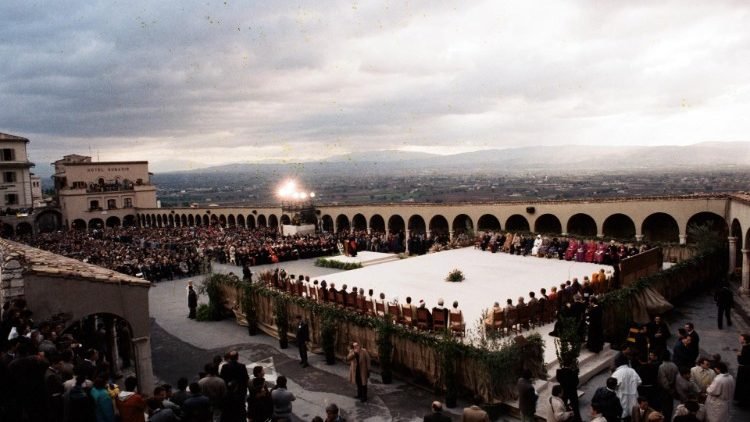
On the 40th anniversary of the historic Day of Prayer for Peace, convened by Pope John Paul II on October 27, 1986, the legacy of the “Spirit of Assisi” spans four pontificates. From John Paul II himself, who explored its theological significance, to Benedict XVI, who extended the dialogue to include non-believers; from Francis, who calls for fraternity, to Pope Leo XIV, who invites religions to rediscover within their own roots an antidote to hatred and violence.
By Fabio Colagrande
Never before had a Pope convened representatives of the world’s major religions for a day dedicated to peace. On 27 October 1986, John Paul II chose Assisi—the city of Saint Francis—for an unprecedented initiative, one destined to leave a profound mark on the history of interreligious dialogue. Forty years later, that event remains one of the most significant gestures of his pontificate and a touchstone for his successors.
There was the sight of young Jewish people offering olive branches to religious representatives—most notably to Muslims—a gesture that moved Cardinal Roger Etchegaray, whom Pope John Paul II had tasked with “orchestrating” the gathering, to tears. There was the exchange of the sign of peace among the leaders of Christian Churches inside the Cathedral of San Rufino, with visible emotion etched on the faces of some of the participants. There were the leaders, shivering from the cold and huddled close together on the stage in front of the basilica, and the rainbow that appeared after a grey morning—details that remained in the recollections of Cardinal Etchegaray, who saw the rainbow as a sign of fraternity. These are some of the enduring images from that historic day, which was conceived to bear witness to a shared commitment to peace—a commitment that respected diverse religious convictions, with each person engaged in prayer according to their own tradition.
Beyond mere memories, that day gave rise to what is known as the “Spirit of Assisi”—a commitment by various religions to meet, engage in dialogue, and build peace together. It became a touchstone for the Church’s magisterium—a gesture to be interpreted, refined, and developed. Cardinal Roger Etchegaray summarized its guiding principle using a phrase from John Paul II: “To be together to pray, but not to pray together.” Following the path set by Nostra aetate—the Second Vatican Council’s declaration on the Catholic Church’s relations with non-Christian religions—this dialogue took on a visible form, without erasing existing differences. From Pope John Paul to his successors, the reflection has repeatedly returned to the relationship between prayer and peace, religious identity and encounter, and faith and responsibility toward humanity.
The Council, reinterpreted through an event
“The very identity of the Catholic Church and its self-awareness were strengthened at Assisi,” John Paul II stated on 22 December 1986, while addressing the Roman Curia during his traditional Christmas greeting—offering, in the process, a theological interpretation of the gathering. The Pontiff seemed to suggest that it is not enough simply to be pleased with the event’s success; one must understand it in the light of faith. Its foundation lies in the unity of the human family, rooted in creation and the saving work of Christ. Assisi made this unity visible without obscuring religious divisions. The relationship with the Second Vatican Council is, therefore, reciprocal: the Council provides a framework for interpreting the event, while the event, in turn, helps to re-examine the Second Vatican Council with greater depth. Dialogue does not weaken ecclesial identity; rather, it can make the Church more conscious of its own mission of reconciliation.
The ‘Spirit’ beyond visible boundaries
Four years later, in the encyclical Redemptoris missio, dated 7 December 1990, John Paul II revisited this conviction—which he had previously expressed before the Roman Curia—by explicitly referencing Assisi. “Every authentic prayer is prompted by the Holy Spirit, who is mysteriously present in the heart of every person,” Pope John Paul affirmed. This was a decisive turning point: the experience helped to reshape the understanding of the role of interreligious dialogue within the Church’s mission. Recognizing the action of the Spirit in others does not stand in opposition to the proclamation of Christ; rather, it is situated within the singular divine plan for salvation. Assisi—with “any ambiguous interpretation” ruled out—bears witness that respecting a person in their religious quest is, in fact, respecting the work of God within them. Dialogue, therefore, is grounded in a theological rationale, not merely a diplomatic or humanitarian one.
No violence can be called religious
On 24 January 2002, John Paul returned to Assisi—this time by train—at a time when terrorism, hatred, and conflict loomed over the international landscape. The gathering took place just a few short months after the attacks of 11 September 2001, and the act of prayer became a public assumption of responsibility: religious communities must repudiate violence—especially violence that seeks to legitimize itself in the name of God. “Whoever uses religion to foment violence contradicts its most authentic and profound inspiration,” the Polish Pontiff declared. He went on to link peace with justice and forgiveness, while reaffirming the distinct nature of various forms of prayer. It was not a matter of a single, common religion, but rather a shared commitment: each person, remaining faithful to their own tradition, is called to defuse hostility. To pray does not mean to escape from history, but to engage with it responsibly. Even those who seek without believing
On 27 October 2011—the 25th anniversary of the first prayer meeting for peace—Benedict XVI extended an invitation to those who do not profess a faith but are nonetheless in search of the true and the good. This was not merely the addition of new guests; their presence also posed a challenge to believers. “They are pilgrims of truth, pilgrims of peace,” Pope Benedict explained. The image of God can be obscured by the way in which religions are lived out; no one can claim God as their own exclusive possession, nor feel authorized to impose themselves upon others on that basis. In this way, Benedict XVI developed an imperative inherent to the “spirit of Assisi”: the need to purify the way faith is practiced. In this context, Assisi calls upon believers to conduct an examination of conscience: it is not enough to condemn those who use religion to justify violence; one must also ask whether one’s own way of living and presenting the faith truly reveals the face of a God of peace, or whether it distorts it.
Alongside one another, for one another
“Instead, we prayed alongside one another, for one another.” In Assisi, on 20 September 2016, Pope Francis summarized with these words a continuity that explicitly excludes both syncretism and relativism. Yet, he also emphasized its fraternal dimension: it is not merely a matter of respecting the prayers of others, but of taking responsibility for one another. Dialogue must give a voice to the victims of war, to refugees, and to the poor. Prayer must be matched by concrete cooperation, and encounters must be accompanied by a commitment to address the root causes of conflicts. The threat to be overcome is not only fanaticism, but also indifference. Religious fidelity is also measured by one’s capacity to listen to those who suffer.
Returning to the sources, against hatred
“[B]elievers can draw upon the most authentic sources of their particular spiritual traditions, where there is no room for ‘sanctified hatred’,” Pope Leo XIV states in paragraph 223 of the encyclical Magnifica humanitas, dated May 15, 2026. He explicitly invokes the “spirit of Assisi”—fostered by John Paul II and continued by Francis, including through his dialogue with the Grand Imam of al-Azhar. The legacy of 1986 thus finds its place in social reflection on contemporary challenges: religions can counter the mentality of violence not by diluting their own convictions, but by returning to their original sources.
This is the thread that runs through forty years: the encounter is not a suspension of faith, but a test of it. For believers, Assisi continues to raise the question of whether their relationship with God can become a commitment to peace?

