

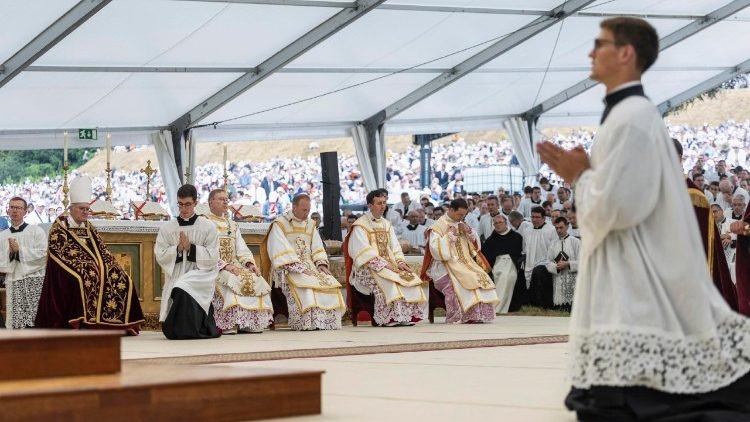
Our Editorial Director reflects on the schismatic act carried out by the Priestly Fraternity of Saint Pius X and the ‘latae sententiae’ excommunications that followed.
By Andrea Tornielli
On this painful day, as the decree was published noting the excommunication automatically incurred at the precise moment of the laying on of hands by the two Lefebvrite bishops de Galarreta and Fellay and by the four newly consecrated bishops, some have rightly pointed out the open contradiction of the Priestly Fraternity of Saint Pius X.
In its words and formal statements, the Fraternity says it recognizes the legitimacy and authority of the Successor of Peter, Pope Leo XIV; that it loves him and prays for him.
In its deeds, however — and deeds always count more than words — it completely disregarded his clearly expressed will, his repeated appeals, and his request not to proceed with schismatic consecrations without pontifical mandate; or rather, with schismatic consecrations explicitly forbidden by the Pope.
In recent days, many have recalled the words of Saint Pius X, the Pope from whom the Fraternity takes its name, who said in 1912: “And how must the Pope be loved? Non verbo neque lingua — not in word or with the tongue — sed opere et veritate — but in deed and in truth… To show our love for the Pope, it is necessary to obey him. Therefore, when one loves the Pope, one does not debate what he commands or requires, or how far obedience must go, or in what matters one must obey.”
Some have also cited the paradox of traditionalists who consider the rite untouchable, yet invent a formula to replace the absence of an essential element in every Catholic episcopal ordination: the Pope’s mandate.
The real point, however, lies elsewhere. And it has nothing to do with the Mass in the preconciliar rite — mistakenly called the “Latin Mass” — since the faithful attached to that liturgical form are still permitted to celebrate it in full communion with Peter.
The true crucial question is what Tradition is, and above all who is to safeguard it while allowing our understanding of Tradition to grow under the inspiration of the Holy Spirit.
If Tradition is crystallized into an ideological system; if people arrogate to themselves the right to judge a Council presided over by two holy Popes, with the participation of three thousand bishops from around the world, which promulgated documents approved practically unanimously; if they demand that the Successor of Peter and the whole Catholic Church accept and make their own the theological ideas of one particular group, there is something profoundly contradictory.
But above all, there is something very far removed from the Catholic faith, whose secret — as the great writer Vittorio Messori, who died this Good Friday and who had worked so hard for the return of the Fraternity of Saint Pius X to full communion, explained — is and remains “both-and,” not “either-or.”
Thus, there is room in the Church for the faithful attached to the ancient liturgy; there is room in the Church for discussion, for reading and rereading documents and interpreting them.
However, there is no room for judging the Pope and disobeying him by carrying out acts that tear the unity of the “Mystical Body” of Christ, which is the Church. N
or is there room for creating a parallel hierarchy against the explicit prohibition of the one to whom Jesus said: “You are Peter, and on this rock I will build my Church.”

