

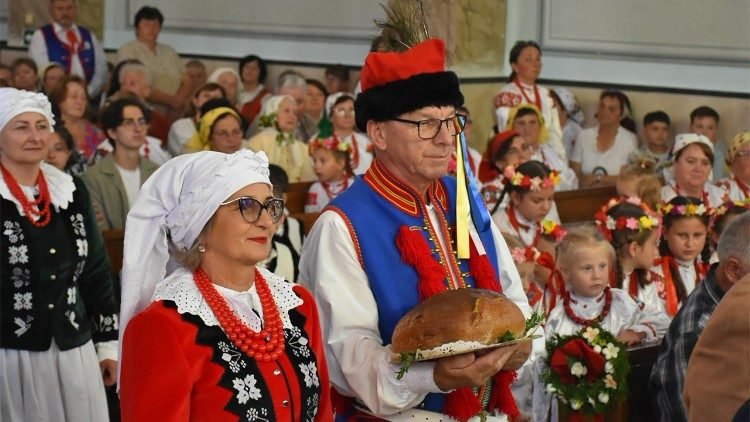
A look at Poland’s traditional harvest thanksgiving celebrations, known as “dożynki”, which Pope Leo reflected on at the General Audience.
By Fr. Łukasz Bankowski
Celebrations marking the end of the harvest season exist in many countries, but Polish “dożynki” have their own distinctive traditions. Elaborate wreaths are woven from ears of grain, flowers, herbs and fruit, while bread is baked from the newly harvested grain. Before the music, dancing and festivities begin, the fruits of the harvest are brought before the altar in thanksgiving.
At the General Audience, Pope Leo XIV referred precisely to this dimension of the celebrations.
“Let us entrust to the Lord the work of farmers, thanks to whom we do not lack our daily bread,” he said. “May Mary, the most beautiful among the flowers of the earth, watch over your families and your fields.”

In Bukovina, Romania, Poles begin their harvest celebration with Mass and the blessing of the produce. (Parrocchia Nowy Sołoniec)
Harvest wreaths brought to Jasna Góra
One of the most important destinations for Poland’s harvest celebrations is the Jasna Góra shrine in Częstochowa, the country’s principal Marian sanctuary. Every year, farmers from across Poland travel there carrying harvest wreaths that represent their towns and regions.
During this year’s celebrations, bishop Krzysztof Nitkiewicz told the gathered faithful that the wreaths speak of the faith and work of entire families who, in gathering the harvest, cooperate with the Creator.
“The earth must be treated with respect, like a mother,” he stressed.
A tradition that travels with Poles
The tradition has also crossed Poland’s borders. In Bukovina, Romania, home to a historic Polish community, Poles in the village of Nowy Sołoniec begin their harvest celebration with Mass and the blessing of the produce. Regional dishes, music and performances by Polish folk groups follow, helping preserve Polish culture and pass it on to new generations.
An even more unusual example is the Polish Catholic Mission in Koblenz, Germany. Its faithful are mainly Polish economic migrants, with no farmers among them. Yet every year the church is decorated for the harvest celebration, and prayers are offered for farmers and for the year’s crops.
“Poles have a deeply rooted conviction that we should thank God for the fruits of the earth and for the good we receive,” Fr. Tomasz Świątek, parish priest in Koblenz, told Vatican News.
There, perhaps, the enduring character of “dożynki” becomes particularly clear: a tradition born in the Polish countryside has survived even without fields or farmers. As Pope Leo XIV suggests, behind our daily bread are the earth, human labor and God’s blessing.

Traditional harvest thanksgiving celebrations (Parrocchia Nowy Sołoniec)

