

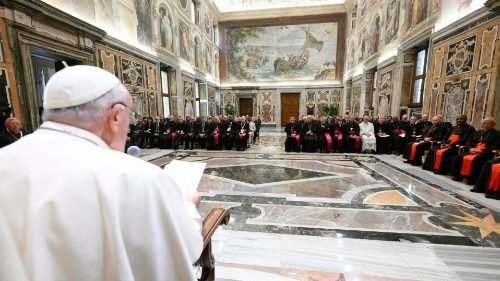
Meeting for their first Plenary Assembly, Pope Francis tells the Dicastery for Culture and Education that they “are morally obliged” to help the 250 million children who do not attend school.
By Kielce Gussie
One of the newest Dicasteries in the Vatican met with Pope Francis on the occasion of their first Plenary Assembly.
The Dicastery for Culture and Education was established in June 2022 after the Pope combined the Congregation for Catholic Education and the Pontifical Council for Culture. The Pope said the move sought “to exploit the potential for dialogue, interaction, and innovation in a way that could enhance the effectiveness of both.”
He began his address by reiterating the importance of the Dicastery’s mission and warned against creating educational models that simply make results.
“Our world does not need automatons,” he explained. “It needs new choreographers, new interpreters of our rich human resources, new social poets.”
What are we really “awaiting”?
Instead of making success or promotions the end goal, Pope Francis challenged the Dicastery Members to “do something quite different.”
To paint an image of this idea, he referenced Emily Dickinson’s poem #323:
As if I asked a common Alms,
And in my wondering hand
A Stranger pressed a Kingdom,
And I, bewildered, stand –
As if I asked the Orient
Had it for me a Morn –
And it should lift its purple Dikes,
And shatter Me with Dawn!
The poem can help the Dicastery, the Pope said, see their mission in education and culture as “calling upon others to broaden their horizons, to overflow with inner vitality, to make space for new possibilities, and, in sharing the gifts they have received.”
No reason to fear
Pope Francis encouraged the group to not be afraid. With Christ as their guide and companion, they are “guardians of a cultural and educational heritage” that goes beyond them.
The philosophical, theological, poetic, and scientific background came from the work and study of their predecessors like St. Augustine and Mozart to Mark Rothko and Blaise Pascal.

The papal meeting took place in the Sala Clementina in the Vatican
The Pope tasked the Dicastery members to spread this plea to everyone: “Don’t forget about hope!”
Yet more than words, he encouraged them to roll up their sleeves and get started.
Cultural genocide and education
“Today, the world has the highest number of students in history,” he pointed out. Even so, about 250 million children and teens are not able to attend school, and the Pope denounced this injustice.
“It is cultural genocide,” he said, “when we rob children of their future by our failure to provide the conditions necessary for them to become all that they can be.”
Pope Francis concluded by challenging the Dicastery to study recent scientific developments and technological innovations to understand their “benefits and dangers.”

