

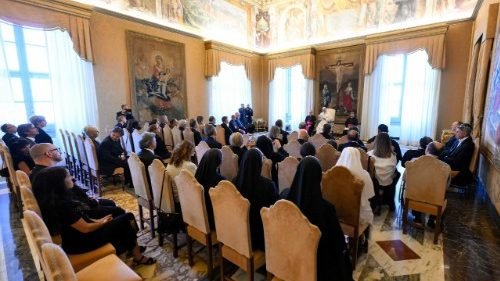
Pope Leo XIV welcomed members of an international study center that bears his name to the Vatican on Friday, encouraging them to take inspiration from authentic humanism and the Church’s social doctrine to contribute to building a civilization of love.
By Christopher Wells
At the Vatican on Friday, Pope Leo XIV held an audience for members of the Leo XIV International Study Center, an initiative of his own Augustinian Order in response to the Holy Father’s call to rediscover the value of the Church’s Social Doctrine as an essential tool in facing the challenges of the modern world.
“From the beginning,” the Pope said, “I have appreciated the Center’s commitment to broad-ranging dialogue with universities, academic institutions, public bodies, civil society organizations, ecclesial groups, and networks, fostering collaborative relationships and exchanges at both national and international levels.” He said “the secret” to this approach “lies in walking together—always—without closing the door to encounters with those who are different”.
Humanism and Catholic Social Doctrine
He encouraged members of the Study Center to draw inspiration from the “values” of authentic Humanism, which, by being open to a Creator, can help build fraternal relationships. “It is not war, but the weaving of peace and just balances that creates civilization,” he said.
Pope Leo also recalled the contributions of the Church’s Social Teaching, emphasizing its “popular” root: “Its reinterpretation of Christian Revelation within modern social, labor, economic, and cultural contexts would be unimaginable without Christian laypeople grappling with the challenges of their times.” At the same time, the response to those challenges requires “continuous interaction” between the faithful and the Magisterium, ordinary citizens and experts, and people and institutions”—interactions he called upon the Study Center to foster”.
A mission of hope
The Holy Father went on to succinctly define their “mission of hope”: to promote “a formation for public and political life understood as service to the common good, responsibility toward the community, and the building of relationships founded on solidarity, justice, and peace”. In this regard, he continued, the Center’s Augustinian connections have “much to offer the current international landscape, fostering an understanding of love as a principle for the renewal of personal, economic, and political life”.
Reflecting the thought of St Augustine, Pope Leo XIV said, “We view history in light of the crucified and risen Lord… we do not interpret the present as a closed destiny, but as a field open to personal and collective conversion”. He concluded his address with an invitation to those present to “be experts in God’s new things: dazzle with speed and efficiency, but those He quietly brings about, freeing the old world from its dead ends and opening paths along which we may advance together towards His city”.

