

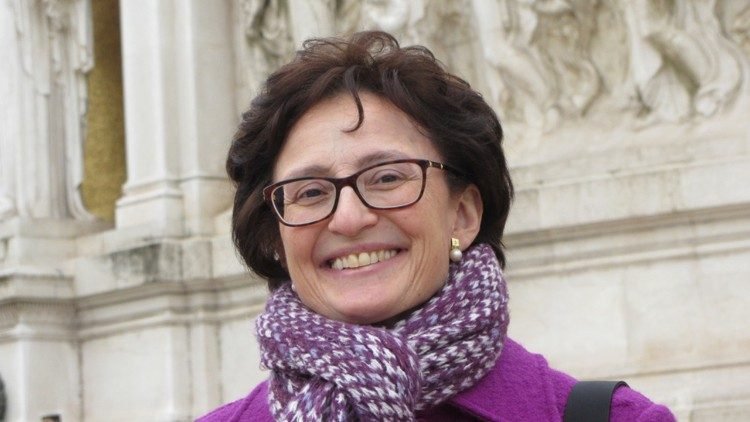
On 9 March 2021, Pope Francis appointed Spanish biblical scholar, Sr. Nuria Calduch-Benages, as secretary of the Pontifical Biblical Commission. She expressed her surprise and gratitude in this interview with Vatican News.
By Debora Donnini
Sister Nuria Calduch-Benages has dedicated her life passionately to the study of the Bible. She teaches Old Testament at the Pontifical Gregorian University and is a reknowned expert on Sacred Scripture. Hailing from Barcelona, Spain, Sr Nuria Calduch-Benages is a member of the Congregation of Missionary Daughters of the Holy Family of Nazareth. She also took part in the work of the Study Commission on the Diaconate of Women (2016-2019). On 9 March, Pope Francis appointed her secretary of the Pontifical Biblical Commission, the Vatican office of which she has been a member since 2014. She was recently reappointed for another five-year term, which will last until 2025.
Among other positions, she is a guest professor at the Pontifical Biblical Institute in Rome, an assiduous collaborator of the Catholic Biblical Federation, a prominent member of specialized journals, serving on the scientific committee of the journal History of Women (University of Florence) and collaborating on the series “Tesis y Monografías” published by Verbo Divino (Estella). In 2008 she participated as an expert in the General Assembly of the Synod of Bishops focusing on “The Word of God in the Life and Mission of the Church.”
Q: How did you react to your being appointed secretary of the Pontifical Biblical Commission and what importance does being a woman have in this position?
A: Two words can sum up my reaction: On the one hand, surprise, because I would never have imagined receiving this appointment; and on the other hand, gratitude to all those people who have confided in me. I think the presence of women in this Commission, as in others, is a positive and important dimension that opens horizons in the Church.
Q: How would you describe your experience of having participated in the Study Commission on the Diaconate of Women?
A: For a good three years, from 2016 to 2019, I was involved, along with the other members, in the study of the diaconate of women. And even if the outcome can be considered partial in some ways, the experience was very enriching both from an intellectual and ecclesial point of view, as well as a human point of view. We established friendships and collaborative relationships that continue to this day. I consider this a privilege.

Sr. Nuria Calduch-Benages
Q: Sacred Scripture is at the core of your studies. What do you think is the unique contribution women can bring to the study of the Word of God?
A: Their expertise, their interests and their perspectives. For example, think of the study of biblical figures who are women, their narratives, the use of female metaphors, feminist hermeneutics, and many other aspects. Forty years ago, when women biblical scholars were almost unheard of, these issues and approaches to Scripture were not given consideration in biblical environments. Today, however, they are highly valued by everyone, men and women alike, and publications are becoming increasingly numerous.
Q: You teach Old Testament. Deborah, Esther, Judith… Women are central in these books of the Bible and show their importance in salvation history. What vision of women emerges from these texts?
A: In some biblical accounts, such as those you mentioned, women appear as true protagonists of Israel’s history, with an important mission to fulfill on behalf of the people. In others, however, they are mere instruments of male power. Yet in others, they are totally silenced by the authors. Therefore, their stories are not told and so we do not hear their voices. This is our main difficulty. Moreover, we cannot forget that the biblical texts are very ancient texts in which women are described according to the archetypes of each era and according to the androcentric perspective of the authors.

