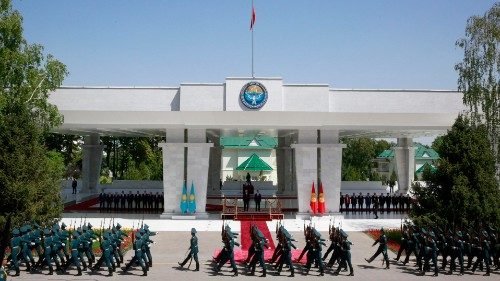
The annual Eurasian Economic Forum has taken place in Bishkek, the capital city of Kyrgyzstan. This Year’s Forum gained significant international interest and impact as Russia’s pivot to Asia and Supply Chain movements placed Central Asia in the spotlight.
By Linda Bordoni
In a global perspective, this year’s Eurasian Economic Forum has taken on far greater significance due to the impact of the Russia-Ukraine war and the stringent sanctions imposed on the Kremlin in retaliation for its invasion of its neighbour.
The Economic Forum is a top-level event of the Eurasian Economic Union that concentrates on regional economic and commercial issues. Member states include Armenia, Belarus, Kazakhstan, Kyrgyzstan, – where the summit was held this year – and Russia.
Era of global changes
The chosen theme: “Eurasian Economic Integration in the era of Global Changes: New Opportunities for Investments”.
Addressing the Forum the Russian President said the development of Eurasian integration has no connection to current developments or market conditions pointing out that it was established many years ago; however, he went on to decry the sanctions imposed on his country saying that their effects are not limited to Russia, or even China, and expressed his opinion that the world is witnessing a global process which sees a growing number of countries that want to and will pursue an independent policy.
Putin was not included in the World Economic Forum that took place in Davos, Switzerland from 22 to 26 May, the closing day of which coincided with the Kryrgyzstan event.
Strategy for the coming years
Several discussion sessions were held within the framework: “Strategy – 2025: Forming a Vision of the EAEU Future, New Areas and Directions of Cooperation.”
Talks focused on the further liberalisation and commonality of trade, tariffs and customs regulations between each of the member states and countries with which the EAEU has Free Trade Agreements. One of the issues that were pinpointed was the fact that the bloc has suffered in the past from a lack of coordination in trade, quality and standardisation issues.
The sessions dedicated to “Projecting Eurasianism Into the Future” focused on a more abstract view of what Eurasianism really means. Is it Central Asia? Does it include the entire landmass from China to the European Union? – and finally: “Interaction between the EAEU and International Partners” and how to develop it.