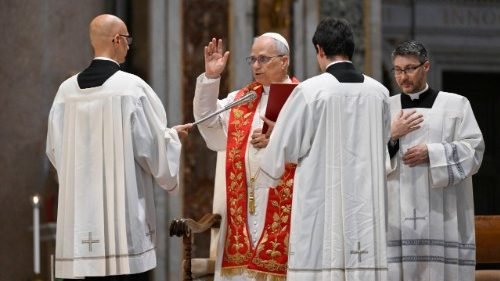
The Vicar General of Rome speaks to Vatican News about the Church in the Eternal City, noting that “in Rome, it is difficult to die of hunger, but people certainly die of loneliness”.
By Eugenio Bonanata and Orazio Coclite
There is great anticipation ahead of Pope Leo’s visit tomorrow afternoon, 18 September, to the Basilica of St John Lateran.
The Pope will preside over the Diocesan Assembly, as he did for the first time on 19 September 2025, officially opening the new pastoral year.
“We are strengthening the bond between the bishop and his Diocese,” says Cardinal Vicar Baldo Reina, who spoke to Vatican News ahead of the event.
The programme
The gathering, attended by representatives of all 334 parishes in the Diocese, will begin and end with a time of prayer and will include an introductory address by the cardinal, three testimonies, and then concluding remarks by Pope Leo.
“An hour at most, all told,” the cardinal predicts, adding that the speakers will be a family, a young person and a Caritas worker.
The cardinal also gives an idea of what will be presented to the Pope during the gathering, taking into consideration the Pope’s own guidance at last year’s Assembly, when he called for the Diocese to mature in terms of synodality, communion and mission.
“We have made progress that needs to be strengthened and consolidated,” Reina says, citing several areas in which significant investment has been made, including participatory bodies within the parishes.
Work is also under way to create a network among neighbouring parishes, with the aim of encouraging the sharing of experiences, starting with those communities that are particularly active and may benefit from the contribution of more highly trained pastoral workers. Finally, Reina says, the diocesan pastoral council has been strengthened, while advisory bodies covering specific areas have been retained.
Major emergencies
The conversation then turns to warning signs coming from Rome’s parishes.
“The first major concern,” the cardinal vicar stresses, “concerns the family: the weakening of bonds within households, the challenges of raising children and the weakening of everything connected with the institution of the ‘family’.” Another issue, closely linked to the previous one, is problems for young people, who often struggle with addiction. Then there is the issue of poverty, which is not limited to access to food: “In Rome, it is difficult to die of hunger, but people certainly die of loneliness; they die because they lack work; they die because not everyone has a home.”
It is precisely on this last front that the city is facing a genuine emergency. “Housing poverty is becoming increasingly serious: market forces are driving prices beyond the reach of people on an average salary. And in a household where only one person works, they cannot even afford to pay the rent.”
Reaching out
One further aspect completes the picture. “The proclamation of the Christian faith is struggling to connect with people’s everyday lives,” Cardinal Reina continues. He emphasises: “We would like to return to the centrality of Christ, to which the Holy Father called us back last year, already looking ahead to the Jubilee of Redemption in 2033.”
In this regard, the Diocese of Rome, rich and complex at the same time, has a particular characteristic: “Most of the churches are concentrated in the city centre, while most people are concentrated in the outskirts.”
“What I frequently ask priests to do,” Reina confides, “is to pay close attention to those who, for various reasons, no longer set foot in our parishes. Unfortunately, because of the way our communities are structured, we often focus on the people who come to church. But the Kingdom of God goes beyond the boundaries of the parish , and the Lord Jesus is very clear in the Gospel in giving his disciples, and us today, a missionary mandate that embraces everyone.”
It is not easy, but for the cardinal it is a viable path and, moreover, one that cannot be postponed. An encouraging sign, to be recognised and explored further, comes from the huge numbers of young people who took part in the Jubilee of Youth last summer. “There is a widespread need for God in our city. And it is in service of this need that we must try to put all our strength and potential at the disposal of others.”