

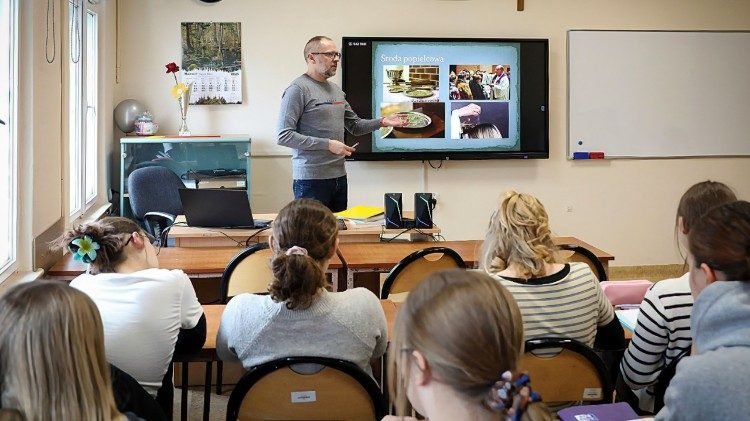
Poland’s new rules on religion classes in public schools are raising concerns among parents, catechists and bishops, who say the changes could make it more difficult for students to attend.
By Fr. Łukasz Bankowski
Although religious education is optional in Polish public schools, 75.6 percent of students attended religion classes during the 2024/2025 school year, according to the Institute for Catholic Church Statistics (ISKK). Parents, catechists, and bishops argue that the new rules could make it more difficult for many students to attend these classes.
Children discouraged from attending religion classes
Arkadiusz Kuznacki, from Wschowa in western Poland, is the father of two children, one in first grade and the other in eighth grade. He told Vatican News that for several years he has observed religion being given an increasingly marginal place in school timetables.
Last year, his daughter’s religion class was scheduled very late in the school day. After finishing her regular classes, she had to wait an additional hour before the religion lesson began.
“In practice, the timetable is being arranged in such a way that children will not attend religion classes,” he said.
In his view, religious education also helps young people assess information about faith that they encounter online. Parents pass on the faith to their children, he says, but catechists have theological training that enables them to present Church teaching systematically.
Catechist: Commuting students are particularly affected
Aneta Rayzacher-Majewska is beginning her 23rd year teaching religion in schools. She stresses that religion classes provide a space where students can ask difficult questions, challenge their own ideas about God and the Church, and learn about the Christian roots of European culture.
She is critical of scheduling religion as either the first or the last lesson of the day. In some cases, this means students must arrive at school as early as 7 a.m. or remain there after all their other classes have ended.
The arrangement is particularly difficult for students who commute to school.
“Sometimes, in practice, it forces them to withdraw from religion classes,” she said.
In her view, parents may likewise find themselves pushed into making a decision that conflicts with their convictions, leaving them with less freedom to choose religion classes for their children.
Bishops: Changes are unfair to students and parents
“The decisions of the Ministry of National Education concerning religion classes are unfair,” Bishop Wojciech Osial wrote in a message marking the beginning of the school year.
Bishop Osial, chairman of the Catholic Education Commission of the Polish Bishops’ Conference, stressed: “We do not accept the marginalisation of religion classes.”
Speaking to Vatican News, he explained that if even one student in a class does not attend religion, the lesson for the others must normally be scheduled before or after regular classes. As a result, they must come earlier or stay later.
Bishop Osial said Church representatives had proposed a different solution during talks with the Ministry: every student would choose between religion and ethics and attend one of the two subjects.
“Today, especially when we see a crisis of values among young people, such a solution would benefit both believers and non-believers,” he said.
Bishop Marek Mendyk, former chairman of the Catholic Education Commission of the Polish Bishops’ Conference, stressed:
“There is an attempt, at all costs — including through deceptive means and violations of the law — to remove religion from schools”.

