

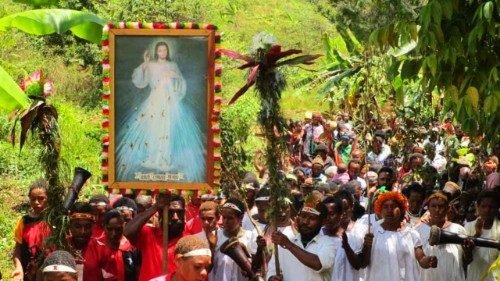
From August 14 to 17, 2026, the diocese of Bougainville is celebrating 125 years of Catholic missionary presence in the North Region of the country. They honor the generations of missionaries, catechists, and local faithful who sustained the Church through war, crisis, and social change.
By Sr. Christine Masivo, CPS
As the Diocese of Bougainville in Papua New Guinea marks a historic 125 years since the arrival of the first Catholic missionaries, their celebration is more than a commemoration of the past. The Church has endured hardship and wars over the more than a century in the country, developing into a vibrant local community of more than 200,000 Catholics across 35 parishes.
From mission stations to parishes
Rooted in the early Marist arrivals at Pokpok in 1901 and Buin in 1903, the local Church has grown as a result of the dedication of missionaries and lay catechists. The faith survived World War II and the Bougainville crisis – a conflict that lasted from 1988 until 1998 between the Papua New Guinea government and secessionist forces on the island of Bougainville.
The anniversary’s grand finale – held from the 14 – 17 of August 2026 – will bring history to the present, with Cardinal Luis Antonio Tagle, who will preside over the solemn Jubilee Mass on August 16 at Our Lady of the Assumption Cathedral in Hahela. His visit will also include parish and hospital ministry, meeting the regional leaders, and blessing of a new diocesan building.
Moving towards local leadership
Fr. Christian Sieland, the National Director of the Pontifical Mission Societies, grew up in Papua New Guinea at a time when almost 90% of the local church was foreign missionaries, according to the Vatican’s Fides news agency.
“My father was a lay missionary recruited by the Misereor in Germany, and he worked side by side with priests and religious brothers and sisters for over 20 years,” he said. Today, Fr. Sieland is a local clergyman who stands at a decisive moment of the transition from the missionary church to a fully local church.
“I believe the most vital values I have inherited are respect and appreciation,” the priest continued. “My own vocation was shaped by both family and missionary witness.” After volunteering with the Society of the Divine Word (SVD) in Papua New Guinea from 1999 to 2000, his friendship with missionaries awakened his vocation to priesthood.
Faith, culture and reconciliation
The Church in Papua New Guinea has passed through generations of missionary service. The 1990s and 2000s brought a significant increase in indigenous vocations, creating today’s generation of local Christian leaders.
Papua New Guinea is one of the world’s most culturally diverse nations, with more than 800 languages and numerous ethnic and tribal communities that create divisions but can also be a source of profound unity.
The Church has helped build that unity through building schools, providing health services, and creating pastoral communities that bring people together across tribal boundaries. “Within parish pastoral councils, it is not unusual to see members of historically rival communities working together as one Christian family,” Fr. Sieland said.
However, serious challenges still remain. Trivial fights, political divisions, sorcery-related accusations, violence, and traditional systems of retaliation continue to cause suffering in some communities. “The Church seeks to address these realities with both pastoral sensitivity and clarity about practices incompatible with Christian faith,” he explained.
Pastoral centers provide training in conflict resolution, peace mediation, and support for victims of domestic violence and sorcery accusations. Church-trained mediators are sometimes called upon to enter areas affected by active tribal conflict, and Fr. Sieland highlighted this, saying that through such work, the Gospel becomes more than a message proclaimed from the pulpit. It becomes a practical force for healing and reconciliation.
The future of the Melanesian Church
There is a rich diversity of tribes and cultures, and inculturation remains an ongoing journey. “Our people must be encouraged to preserve their languages, cultural heritage, and values while making the Gospel genuinely their own,” said Fr. Sieland. Respect and appreciation for the past are essential if the faith is to take deeper root.
“Papua New Guinea is blessed with their national saint, St. Peter ToRot, who offers a powerful image of this unity,” said Fr. Sieland. Though he came from Rabaul, Catholics throughout the country claim him as their own because he is remembered as a catechist, martyr, and faithful Catholic. This shows the incredible opportunities we have to build true communion.
After 125 years in Bougainville and more than a century of Catholic evangelization elsewhere in Papua New Guinea, the Church stands at a new threshold. The missionaries of the past have laid the foundations. Today’s local Church must build upon them.
The challenge is substantial, but so is the hope. If faith, culture, reconciliation, and local leadership continue to grow together, the next generation can inherit not simply a church that survived its history, but one capable of transforming the future.

