

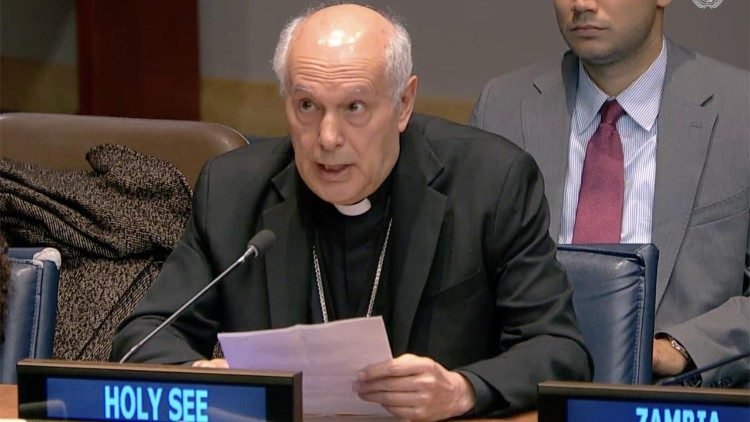
Archbishop Gabriele Caccia, the Permanent Observer of the Holy See to the United Nations, called for nations to help individuals, families, and other groups to achieve the common good by promoting social development and social justice.
By Isabella H. de Carvalho
Social development and social justice must aim to achieve the common good and states should help citizens reach this objective, said Archbishop Gabriele Caccia, the Permanent Observer of the Holy See to the United Nations, on Wednesday, February 4.
“The state must guarantee the cohesion, unity, and organization of society to enable the common good to be achieved with the contribution of every citizen,” he explained at the United Nations headquarters in New York, during the 64th session of the Commission for Social Development, which took place from February 2-10.
He highlighted that “the responsibility for achieving the common good belongs to both individuals and the state,” but “individuals, the family, and intermediate groups cannot achieve their full development alone.”
“Political institutions exist to provide people with the material resources and freedoms required to achieve cultural, moral, and spiritual goals,” he continued.
He also called on governments to “respect and support the family, and provide appropriate assistance when necessary,” as it is the “natural and fundamental group unit of society” and fosters values such as inclusion, solidarity, and social integration.
Place human dignity at the center
Archbishop Caccia underlined that “to achieve social justice and social development, it is vital to place the good of the human person and respect for his or her dignity at the center of efforts.”
This means ensuring that people’s basic needs are met, such as food, water, shelter, quality healthcare and education, and freedom, he explained. He added that this calls for “effective coordination” within and between governments, as well as with stakeholders such as faith-based organizations.
“Such coordination must respect the principle of subsidiarity, promoting collaboration with affected communities to ensure that policies reflect the needs and priorities of those they aim to serve.”
Address the structural causes of poverty
Archbishop Caccia also recalled Pope Leo XIV’s appeal in his Apostolic Exhortation Dilexi te to address urgently “the structural causes of poverty,” as society “needs to be cured of a sickness which is weakening and frustrating it.”
“The deprivations of poverty, unemployment, and social exclusion are not only material, but also spiritual and moral in nature, leading to discouragement, despair, and loneliness,” the Permanent Observer said.
“The Holy See remains firmly committed to social justice and social development and will continue to support all efforts which promote the common good and the integral development of each person,” Archbishop Caccia concluded.

