

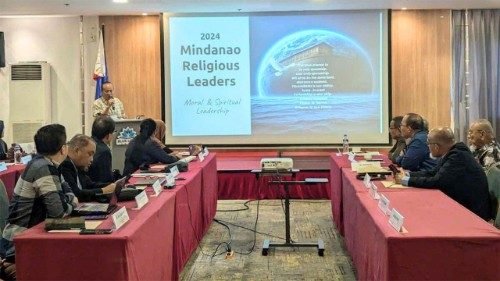
Religious leaders in Mindanao have reaffirmed their commitment to peace and sustainable development during the Mindanao Religious Leaders Conference (MiRLeC), held recently in Davao City.
By Mark Saludes – Philippines, LiCAS News
The MiRLeC gathering, which brought together key figures from different religious communities, culminated in a declaration emphasizing the role of faith in fostering peace in the conflict-affected region.
“We are peacemakers. Peace based on justice is our duty,” read the final declaration of the conference.
The leaders said this commitment “is guided by the values of love, justice, harmony, respect, integrity, unity, reconciliation, spirituality, and humanity.”
Fr. Rex Rocamora, executive secretary of the Commission on Interreligious Dialogue of the Catholic Bishops’ Conference of the Philippines, said MiRLeC convened 24 Muslim Ulama and leaders, 20 bishops and Christian leaders, three Indigenous Peoples representatives, and 10 members of the Civil Society Organizations as observers.
The priest, who serves as the MiRLeC focal person, said the first meetings occurred in August aimed at revitalizing the Bishops-Ulama Conference (BUC), which was established in 1996.
BUC was created in response to the peace agreement signed between the Philippine government and the Moro National Liberation Front.
The religious leaders acknowledged their moral obligation to become a “dynamic peace movement” that contributes to governance and the pursuit of peace, not just in Mindanao but across the country.
Their efforts, they stressed, are crucial in maintaining peace in the Bangsamoro Autonomous Region in Muslim Mindanao (BARMM) and beyond.
The declaration highlighted the importance of interreligious dialogue in promoting peace between Muslim, Christian, and indigenous communities by fostering “interreligious cooperation in the spirit of solidarity.”
The leaders also addressed key challenges facing the region, including the marginalization of the Sulu Islands, environmental injustice, extremism, and terrorism.
They emphasized the importance of initiating “dialogues and conversations of peace” with political leaders, youth organizations, and indigenous peoples’ groups.
In these efforts, prayer and spiritual gatherings were acknowledged as vital components in building solidarity across different faiths.
“There is a need to do more consolidated peace engagements, such as cascading peace dialogues and conversations, consolidating peace constituencies, dialogue with political and other leaders, and advocacy for women, youth, and Indigenous People’s empowerment,” the declaration read.

