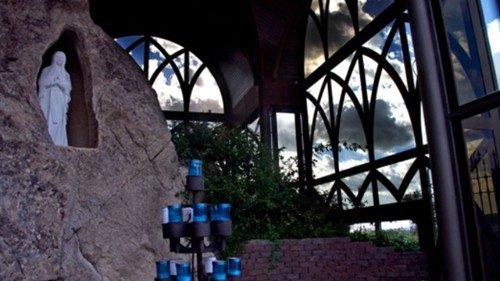
On the basis of the new norms on alleged apparitions, the Dicastery for the Doctrine of the Faith has published its ruling on the spiritual fruits that followed from alleged apparitions to Cosimo Fragomeni in Calabria.
Vatican News
“In the secularized world in which we live, in which so many spend their lives without any reference to transcendence, the pilgrims who approach the Shrine of the Rock are a powerful sign of faith,” writes Cardinal Victor Manuel Fernández.
Responding to a query from Bishop Francesco Oliva of Locri-Gerace, the Prefect of the Dicastery for the Doctrine of the Faith, in a letter dated June 3, “confirms the Nihil obstat” proposed by the prelate with regard to events surrounding the Diocesan Shrine of Our Lady of the Rock (“Madonna dello Scoglio”) in Santa Domenica di Placanica, Calabria.
Recognition of an experience of the Spirit
It was there, on 11 May 1968, the Virgin Mary is said to have appeared for the first time to Cosimo Fragomeni, a humble 18-year-old farmer. According to the new Norms published by the Dicastery for the Doctrine of the Faith on 17 May – recalled by Cardinal Fernández in his letter – the nihil obstat “is not to be understood as an approval of the supernatural character of the phenomenon” but rather as recognition of the “spiritual experience” proposed for the shrine.
The diocesan Bishop is therefore encouraged to appreciate the pastoral value and to promote the spread of this spiritual proposal, “including through pilgrimages, gatherings, and prayer meetings,” while “the faithful are authorized to give their adherence” to these events “in a prudent manner.”
A place to encounter God’s mercy
According to Cosimo, the alleged visionary, the first apparition in 1968 was preceded by a beam of light from a sandstone rock located near the young man’s home, which was repeated for the next four days.
In the messages reported by Cosimo, the Blessed Virgin calls for conversion and prayer, expressing a desire to see the Calabrian locality transformed into a great centre of spirituality where people could encounter God’s mercy. Cosimo cleared the area around the rock, made an embankment out of it and quarried sandstone to make a niche in which to place a marble Marian statue, bought in Carrara.
From a simple chapel to a diocesan shrine
The site soon became a destination for pilgrims from all over Italy and even abroad. At first, there was a simple chapel, but the increasing flow of pilgrims prompted the construction of a large shrine.
Meanwhile, in 1987, Cosimo became a Franciscan tertiary.
On 7 December 2008, the then-bishop of Locri-Gerace, Giuseppe Fiorini Morosini, decreed that the religious reality of the “Madonna dello Scoglio” be placed under the pastoral care of the diocesan Bishop.
In 2013, on 22 May, during the General Audience in St. Peter’s Square, Brother Cosimo, accompanied by Bishop Morosini, asked Pope Francis to bless the foundation stone of the “Scoglio” Shrine that was being built. Three years later, on 11 February 2016, the new Bishop of Locri-Gerace, Francesco Oliva, elevated the place of worship to the status of “Diocesan Sanctuary” with the title of “Our Lady of the Rock.” The following year, on 10 July 2017, he entrusted its pastoral care to the Missionaries of Evangelization.
Evident fruits of Christian life
In his letter, Cardinal Fernández emphasizes how the Sanctuary “has attracted the interest of many other faithful people from different backgrounds, especially those who are suffering and sick.”
He notes that, “Over the years, the place has increasingly attracted devout attendance and pilgrimages under the supervision of the competent Ordinary” which has led to “an intense spiritual activity of prayer and listening.”
Cardinal Fernández goes on to quote the words of Bishop Oliva, who wrote, “The fruits of Christian life in those who frequent the Rock [i.e., the shrine] are evident, such as the existence of the spirit of prayer, conversions, some vocations to the priesthood and religious life, testimonies of charity, as well as a healthy devotion, and other spiritual fruits.” All the while, “no critical or risky elements have emerged, much less problems of obvious gravity.”
Bishop Oliva’s request
In a letter sent last June to the Dicastery for the Doctrine of the Faith, Bishop Oliva had proposed the nihil obstat as “the recognition necessary to continue to operate in such a way that those who visit [the Sanctuary] may feel comforted and encouraged to continue, knowing that they are in communion with the Catholic Church.”
In his response, Cardinal Fernández, writes, “In this regard, this Dicastery takes note of your positive report on the spiritual good that is taking place in the [Sanctuary], over which you exercise constant vigilance so that there may be no manipulation of persons, undue financial gain, or serious doctrinal errors that could cause scandal, harm the faithful, or undermine the credibility of the Church.”
Fernández: Veneration of Mary in a clear Christological perspective
The Cardinal recalls that “the correct veneration of Mary, Mother of Jesus, Mother of the Church, and our Mother, must be expressed in such a way as to exclude inappropriate forms of veneration and the use of improper Marian titles. Instead, veneration in a clear Christological perspective is opportune, as the ecclesial magisterium teaches: ‘when the Mother is honoured, the Son […] is rightly known, loved and glorified’ (Lumen gentium, 66).
The presence of the pilgrims before the Virgin, “who for them becomes a clear expression of the Lord’s mercy,” the Cardinal writes in conclusion, “is a way of acknowledging their own inadequacy to carry out the labours of life and their ardent need and desire for God. In such a truly precious context of faith, a renewed proclamation of the kerygma can continue to enlighten and enrich this experience of the Spirit.”
The decree of the Bishop of Locri-Gerace
At the same time as the publication of the Dicastery’s letter, the decree of the bishop of Locri-Gerace was released, which establishes the nulla osta “for the pastoral value of this spiritual proposal as well as its diffusion, including through possible pilgrimages, gatherings, and prayer meetings.”
The faithful “are authorized to give” their adherence, “in a prudent form,” to the “aforementioned devotion.” This does not, however, “imply a declaration of the supernatural character of the phenomenon,” and “the faithful are not obliged to believe in it.”
Any further messages from those involved will be made public only after the Bishop’s judgment.
Meanwhile, Bishop Oliva goes on to invite the faithful to attend a solemn celebration scheduled at the shrine on the afternoon of 5 August.