

“I am the bread of life; whoever comes to me will never hunger, and whoever believes in me will never thirst.”
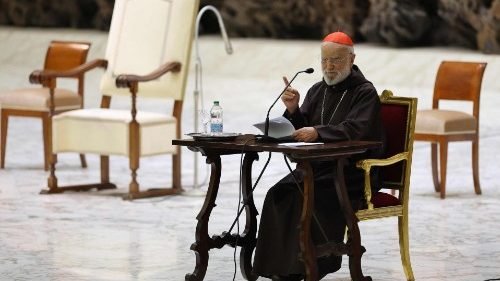
In his first sermon for Lent 2024, Cardinal Raniero Cantalamessa meditated on these words of Jesus from John’s Gospel.
The Cardinal, a Franciscan friar, delivered his homily on Friday morning to the Papal Household. Although he normally attends Cantalamessa’s homilies, Pope Francis – who is currently taking his Lenten retreat – was not present.
Word and Sacrament
“I am the bread of life”.
Where, Cardinal Cantalamessa asked, can we find this bread? The Italian friar identified two places: the Eucharist and Holy Scripture.
In ancient times, he said, the Church recognised Jesus’ presence in both the Sacrament and the Word. It was only later, in the West, that Christians became divided: “On the Catholic side, the Eucharistic interpretation had ended up becoming preponderant … Luther, in reaction, stated the opposite, that is, that the bread of life is the word of God.”
What is needed, therefore, Cardinal Cantalamessa suggested, is a return “to the original synthesis between Word and Sacrament”. This, he said, might be facilitated by the “ecumenical climate” that has flourished in recent decades.
Cardinal Cantalamessa also noted that, although Scripture and Sacrament are sometimes held in contrast in theology, they have always coexisted “peacefully” in the liturgy; since the very early days of the Church, the Mass has included both the Word and the Eucharist.
The grain of wheat
We must, however, Cardinal Cantalamessa said, ask ourselves “a simple question: How did he, Jesus, become the bread of life for us?”
The answer, the Cardinal said, is found in Jesus’ words later on in the Book of John: “‘Truly, truly, I say to you, unless a grain of wheat falls into the ground and dies, it remains alone; but if it dies, it produces much fruit’.”
Thus, he explained, it is not enough to receive the bread of life; we must also allow ourselves to be transformed by it. This means accepting suffering, embracing it as “a means of sanctification and not of hardening of the heart, hatred, and complaint.”
Embracing suffering
Cardinal Cantalamessa then went on to offer two concrete ways that we might live this attitude out.
“One opportunity,” he said, “is to accept being contradicted, to give up justifying oneself, and to always want to be right.” When we do so, he said, we become sanctified in that our “self-love and pride” diminish.
Embracing suffering, Cardinal Cantalamessa said, is also important because it leads to communion.
He quoted from Saint Augustine, who says that, just as wheat must be threshed, winnowed, ground and baked before it can become a loaf of bread, so too Christians must endure fasting, repentance, and exposure to the fire of the Holy Spirit before they can become united in one body.

